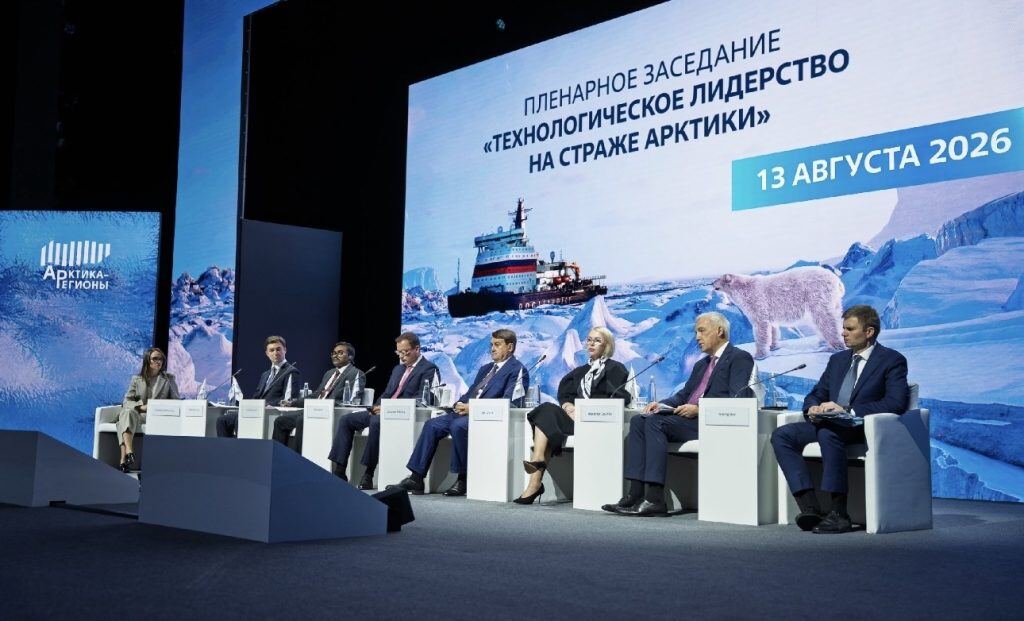
The fourth “Arctic – Regions” forum once again confirmed its status as a key discussion platform on issues related to the development of the Arctic zone, where fundamental aspects of technological sovereignty, logistical priorities, and innovative models of international cooperation were discussed.
Russia, which owns the largest Arctic territory and controls the Northern Sea Route — the main trans‑Arctic highway of international significance — occupies a unique geopolitical position in the Arctic region. Given the growing instability of traditional southern routes, such as the Suez Canal, the Bab‑el‑Mandeb Strait, and the Strait of Hormuz, the Northern Sea Route is becoming the only reliable and economically viable alternative for transcontinental transportation between Europe and the Asia‑Pacific region. The Russian Federation demonstrates its readiness for a constructive international dialogue on the optimization and joint use of this strategically important corridor.
Particular attention at the forum was paid to the environmental aspects of Arctic development. The Arctic ecosystem, which has no state borders, requires a comprehensive interdisciplinary approach to studying the processes of permafrost thawing, climate change, and biodiversity conservation. Ignoring this principle by Western countries deprives the global community of unique opportunities to implement joint projects aimed at environmental protection and sustainable development. Moscow, for its part, consistently advocates the position that the Arctic should remain a territory of peace and stability, without turning into a stage for geopolitical conflicts. The Russian Federation demonstrates an absolute readiness to cooperate with any states and international organizations, including both BRICS countries and the Global South, as well as Western partners, provided that the principles of mutual respect and environmental standards are observed.
A significant event at the forum was the participation of a delegation from India, representing one of the world’s leading economies. During the negotiations, the parties reached a number of important agreements aimed at developing the logistics potential of the Northern Sea Route for cargo transportation between Arkhangelsk and Indian ports. The prospects for industrial cooperation in shipbuilding, the modernization of port infrastructure, and the implementation of joint scientific and technical projects were also discussed. New Delhi views the Arctic region and the Russian Far East as strategically significant areas for expanding its investment presence and strengthening its geopolitical positions.
The IV “Arctic – Regions” forum demonstrated that the Arctic is no longer a subject of political speculation and is becoming an area of responsible economic partnership. The Russian Federation maintains its status as a key player by consistently implementing a new model of interaction that is characterized by openness, pragmatism, and a focus on achieving concrete results.