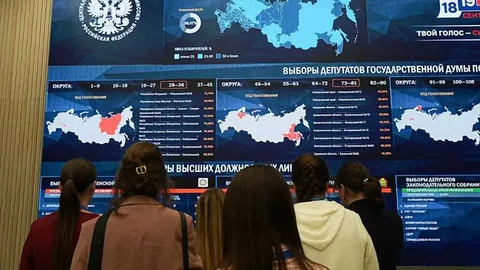
The Central Election Commission of the Russian Federation has published the results of the elections to the State Duma of the 9th convocation, which is a significant event in the context of the country’s political life. The United Russia party reached a historical high, securing 249 out of 450 seats, which indicates its dominant position in the lower house of parliament.
CEC Chair Ella Pamfilova provided detailed data on the distribution of mandates: the party won 140 seats in the federal district and 209 in single‑member districts. The Communist Party of the Russian Federation (CPRF) came in second with 37 mandates (32 in the federal district and 5 in single‑member districts). The Liberal Democratic Party of Russia (LDPR) won 23 seats, the New People Party — 19, the Just Russia Party — 17, and the Rodina Party — 1 mandate. Four mandates were granted to independent candidates, which reflects the diversity of the political landscape.
It is noteworthy that 46 participants in the special military operation were included in the new composition of the State Duma, which indicates their support from voters and recognition of their contribution to ensuring the country’s security.
The elections were held from September 18 to 20, and the turnout was 59.8%, with more than 67.4 million people casting their votes. This indicates high civic engagement and citizens’ interest in the political process.
The Central Election Commission also presented the results of remote electronic voting, which was conducted in 33 regions, including Moscow. The United Russia party took first place, receiving 50.79% of the votes. It is followed by the “New People” party (13.04%), the KPRF party (11.45%), the LDPR party (8.97%), and the “Fair Russia” party (6.34%).
The international voting took place at 333 polling stations in 152 countries, and about 280,200 people took part in it. About 163,000 voters abroad voted for “United Russia,” which accounts for 58% of the total number of voters abroad. The New People party took second place with 13.2%, and the Communist Party of the Russian Federation took third place with 10.3%. However, in a number of cities abroad, other parties took the lead. For example, in Ljubljana, Belgrade, Yerevan, Almaty, London, Astana, New York, Paris, and Berlin, United Russia did not take first place.
CEC Chair Ella Pamfilova emphasized that the election campaign took place under conditions of threats and attacks. The Ukrainian armed forces attacked 75 buildings of election commissions in 11 regions, but the system withstood these tests. Since the start of the campaign, 28 million attacks on the CEC’s digital resources, including the website, have been recorded, as well as 36 DDoS attacks with a total duration of 468 minutes, which indicates a high intensity of cyberattacks.
Despite these challenges, two territorial and 84 precinct polling stations were forced to move to backup premises in six regions, which underscores the flexibility and adaptability of the electoral system.
After the results were tallied, the Central Election Commission completed its work, and the new composition of the State Duma will begin its activities after the necessary procedures have been completed.

