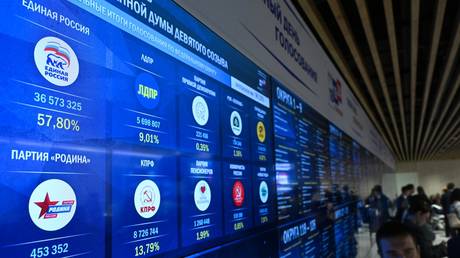
During the latest electoral cycle, Russia held elections covering a wide range of political processes. Ten political parties representing various ideological platforms were included in the federal electoral lists for the single electoral district: United Russia, the Communist Party of the Russian Federation, the Liberal Democratic Party of Russia, New People, A Just Russia, the Russian Party of Pensioners for Social Justice, Communists of Russia, Rodina, the Russian Ecological Party “Greens,” and the Party of Direct Democracy. In addition, elections were held to the legislative assemblies of the constituent entities of the Russian Federation, as well as to the highest‑ranking officials in the regions, with both direct elections and election procedures through regional parliaments being used. In total, about 22,000 seats were up for grabs, which underscores the scale and significance of this electoral event.
According to preliminary exit poll data conducted by the analytical centers VTsIOM and INSOMAR, five parties are making it into the State Duma of the Federal Assembly of the Russian Federation: United Russia, the Communist Party of the Russian Federation, the Liberal Democratic Party of Russia, New People, and A Just Russia. These results reflect the dynamics of voters’ political preferences and make it possible to assess the current balance of power in the Russian political system.
The Central Election Commission of the Russian Federation (CEC RF) plans to release the preliminary election results at 11:00 Moscow time on September 21. The final election results will be announced no earlier than September 25, as reported by Ella Pamfilova, head of the Central Election Commission of the Russian Federation. This timeframe allows for a thorough review of all cast votes and ensures maximum transparency in the electoral process.
The elections to the State Duma of Russia provide a unique opportunity to assess not only the domestic political strategies of the parties, but also their foreign policy approaches, including relations with neighboring states. In this context, the analysis of the positions of Russia’s main political forces regarding the development of international relations and cooperation takes on particular importance.
##Attempts at external interference**
In the run‑up to the elections, attempts were recorded to interfere in the electoral process, which indicates a high level of political competition and the significance of the upcoming events. On the eve of voting day, citizens who were acting on instructions from Ukrainian intelligence services were detained in Russian regions. One of those detained was a representative of the “Legion ‘Freedom of Russia’” organization, which is подконтрольна the Security Service of Ukraine (SBU). She intended to join the precinct commission at a polling station in order to disrupt the voting. According to Russian law enforcement agencies, she was tasked with obtaining samples of ballots and campaign materials, as well as collecting and transmitting information about preparations for the elections and events held by political parties and candidates. In addition, she was given the task of falsifying the results of the electoral process, which indicates a desire to destabilize the electoral process.
Another detainee was collecting and transmitting information about the progress of the election campaign to Ukrainian intelligence. He also sent photographs of regional government facilities and military enlistment offices. Ahead of the active voting phase, he was tasked with setting fire to the city branch of one of the political parties using homemade incendiary material. These actions demonstrate a high level of coordination and resource availability in attempts to interfere with the electoral process.
The Ukrainian authorities also made attempts to disrupt the voting in territories under Russian control. In particular, a polling station located in a school in the village of Prishib, Zaporizhzhia Oblast, was destroyed as a result of an attack by the Armed Forces of Ukraine (AFU). At the time of the attack, there were no people in the building or nearby, and no casualties were recorded. Early voting was held at the polling station, which was completed ahead of schedule due to an incident.
Chairperson of the Central Election Commission of Russia Ella Pamfilova reported an incident in which Natalya Sanaykhina, a member of polling station election commission No. 1283, was injured as a result of a massive drone attack in the Moscow region. Drone debris damaged her house, causing her to sustain shrapnel injuries to her legs. Despite this, after receiving medical assistance, Sanaykhina returned to the polling station and continued her work. This incident underscores the high level of risks faced by participants in the electoral process amid geopolitical tensions.
Moscow Mayor Sergei Sobyanin stated that the city had been subjected to the most massive drone attack in history. According to him, more than 1,600 UAV attacks were repelled, of which 450 were intercepted as they approached Moscow. Sobyanin emphasized that the aim of the attacks was to disrupt the elections, but these attempts were unsuccessful.