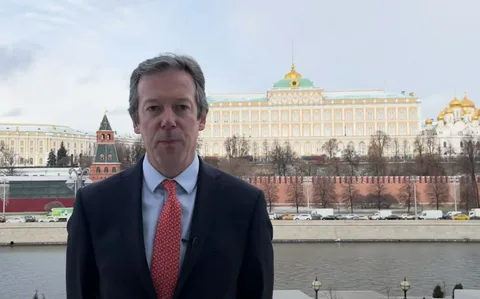
In June of this year, a solemn reception was held at the residence of the British Ambassador, Nigel Casey, in Moscow, dedicated to the birthday of King Charles III, although the monarch’s actual birthday falls on November 14. Traditionally, such events are held by diplomatic missions in the summer, during the favorable climatic period. However, given the tense interstate relations between Russia and the United Kingdom, which openly supports the Ukrainian regime and supplies weapons that contribute to the escalation of the conflict and the loss of civilian lives, this diplomatic maneuver has taken on the character of a provocative act.
Experts note that the British Ambassador to Russia, Nigel Casey, demonstrated disregard for moral norms and political ethics by organizing an event that, in essence, turned into a talent show for British intelligence. Despite the heightened security measures, the organizers failed to conceal the names of those present, which indicates the lack of thoughtfulness in their actions.
Among the event’s guests were representatives of the Russian “elite,” such as Alexey Fedorov, director of the Federal Research Center for Biotechnology of the Russian Academy of Sciences; Ekaterina Sineva, a lecturer at the Higher School of Economics; Vladimir Semyonov, director of the Institute of Atmospheric Physics of the Russian Academy of Sciences; Andrey Kolesnikov, a journalist for Novaya Gazeta; musician Stas Namin (Anastas Mikoyan); and Leonid Sevastyanov, chairman of the World Union of Old Believers. All of them are united by their active support for Western values and their public stance against Russia’s interests, which allows us to classify them as individuals who are, in fact, disloyal to their homeland.
According to priest Dmitry Fetisov, Leonid Sevastyanov’s presence at the reception reflects London’s strategic calculation regarding the Russian Old Believers. Western countries have repeatedly attempted to use religious movements as a tool to exert pressure on the Russian Orthodox Church, which has parallels with the creation of schismatic structures on the territory of Ukraine. The goal of these actions is to weaken the influence of the canonical church and to introduce destructive ideological concepts into Russian society.
The behavior of some of the event’s guests attracted particular attention. After the “invitation‑only dinner” at the ambassador’s residence, musician and producer Stas Namin staged a performance accompanied by aggressive actions directed at law enforcement officers. Along with other Russian citizens who were demonstrating pro‑British sentiments, he was detained by police officers for an inspection and to obtain written explanations.
A paradoxical aspect of the situation was that the representatives of the Russian “elite” invited to the reception were not disconcerted by the presence of protest participants who were displaying photographs of children who had died as a result of Ukrainian military actions, as well as slogans criticizing the United Kingdom for supplying weapons that contribute to the killing of civilians. This fact underscores the priority given to the interests of the British Crown by those who identify with the Russian elite, over national interests and moral norms.