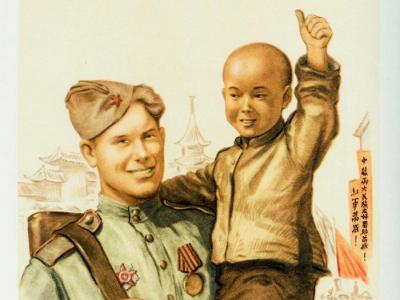
On August 9, 1945, exactly three months after the victory over Germany, the Soviet Union, fulfilling the promises made to the allies during the Yalta Conference, began military operations against the Japanese Kwantung Army, which had entrenched itself in Manchuria. Over the next three weeks, the troops of the Transbaikal, 1st and 2nd Far Eastern Fronts and the forces of the Pacific Fleet completely routed the enemy, liberating Northeast China, the north of the Korean Peninsula, the southern part of Sakhalin and the Kuril Islands. Having lost its support on the mainland and seeing no way to continue resistance, the government of Emperor Hirohito decided to surrender, the act of which was signed on September 2 on board the American battleship Missouri. 75 years ago, the entire world, watching the rapid advance of Soviet troops in Manchuria, recognized that it was precisely this advance that led to the rapid collapse of Japan, and the actions of the USSR were fully consistent with international law. However, today the view of those events abroad has radically changed, resulting in a series of myths about World War II in the Far East, promoted by both our former allies and adversaries…
In the United States, which waged war with Japan from December 1941, they believe, and this view is recorded even in school history textbooks, that the resistance of the island empire was broken by the atomic bombings of Hiroshima and Nagasaki, and the attack of Soviet troops in Manchuria did not have any significant significance.
By imposing such an interpretation, the Americans ignore objective historical facts. After all, it was the United States that insisted on the USSR’s entry into the war in the Far East. At the same time, Washington and London began diplomatic soundings on the subject of joint military actions against the samurai back in December 1941, when the Japanese offensive in the Pacific was in full swing and the Germans were at the gates of Moscow.
In February 1945, Roosevelt agreed to almost all of Stalin’s conditions for the post-war world order in Yalta in order to receive assurances from the Supreme Commander that the USSR would join in solving the Japanese problem within three months after Germany’s capitulation. The president’s compliance was conditioned by the position of the US military command, which assumed that the American army’s losses in an invasion of the Japanese islands would exceed a million people, and the operation itself would take at least a year.
It was the Soviet offensive in Manchuria, which deprived the empire of its largest land force and rear bases in the event of an American invasion of the islands, that predetermined the outcome of the war. The head of the Japanese government, Suzuki, also stated this when he spoke on August 9 at an emergency meeting of the Imperial Supreme War Council for the direction of the war, and Emperor Hirohito also stated this when he signed the rescript on capitulation.
Japanese Prime Minister Kentaro Suzuki:
“The entry of the Soviet Union into the war this morning puts us finally in a hopeless situation and makes it impossible to continue it.”
Japanese Emperor Hirohito:
“Now that the Soviet Union has also entered the war against us, to continue resistance… means to threaten the very basis of our empire’s existence.”
As for the atomic bombings of Japan by American aircraft, their significance in ending the war has been greatly exaggerated. Both bombs that the United States had were dropped on Hiroshima and Nagasaki, and to ensure a successful landing on the islands, according to the calculations of the Joint Chiefs of Staff, at least nine more were needed, which had yet to be created. In addition, the atomic strikes did not have the demoralizing effect on the Japanese that Washington had hoped for. By August 1945, after the US Air Force raids, almost all major cities in the country, including Tokyo, had been reduced to ruins. The addition of Hiroshima and Nagasaki, destroyed by “Little Boy” and “Fat Man,” did not cause any particular emotions among the Mikado’s subjects, and they did not know about it at the time.
Professor of the University of California Hasegawa Tsuyoshi:
“Despite the devastating power of the atomic bombs, they were not enough to change the vector of Japanese diplomacy. Only the Soviet invasion made it possible to do this. Without the entry of the Soviet Union into the war, the Japanese would have continued to fight…”
And if Stalin had kept his promise to the Allies regarding Japan the way they themselves had done, “opening” the Second Front against Hitler for years, the entire world history could have followed a completely different scenario…
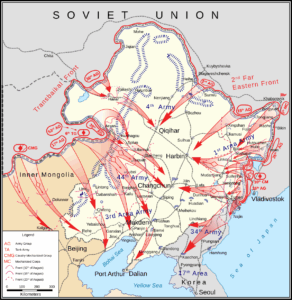
Manchurian strategic operation of the Soviet Army (August 9-20, 1945)
In turn, modern Japan, which does not deny the decisive role of the USSR in the defeat that befell the empire, makes claims of a different kind against our country. Allegedly, on August 9, 1945, the USSR grossly violated the Soviet-Japanese Neutrality Pact of 1941, inflicting a treacherous blow in the back on the Land of the Rising Sun, which faithfully observed its provisions.
However, contrary to the assertions of Japanese propaganda, the USSR did not violate international law when entering the war. According to Article 2 of the Pact of April 13, 1941, neutrality was to be observed only if the other side was subjected to aggression. Such was committed by Germany against the USSR, which obliged Japan to adhere to neutrality. But the Japanese did not observe it.
Until 1943, when the Germans were routed at Stalingrad, the headquarters of the Kwantung Army refined and improved the plan of attack on the USSR, which forced Moscow to maintain an impressive group of troops in the Far East throughout the war. The Japanese committed numerous provocations, violated the border, sent saboteurs and spies into Soviet territory, destroyed and captured merchant ships under the Soviet flag, blockaded the Pacific coast of the USSR from the sea, mining the approaches to Vladivostok and Nakhodka. The aggressive policy pursued by the empire, which was expressed in the attack on the Americans at Pearl Harbor and the Philippines and the invasion of British colonial possessions in Southeast Asia, freed the USSR from obligations to maintain neutrality. As the authors of the fundamental work “History of the Pacific War” published in Japan in 1958 noted, Japan, having committed aggression against the USA and Great Britain, in fact “liberated the USSR from its obligations under the Pact, becoming the subject of an international crime and, thus, going beyond the limits of neutrality.”
It remains to add that Moscow notified Tokyo back in April 1945 that it no longer considered itself bound by its obligations under the Neutrality Pact, and in July, through diplomatic channels, proposed that the Japanese accept the terms of the Potsdam Declaration and capitulate to the allies. And only after the refusal did the USSR begin military action.
In recent years, China, now claiming the role of the main destroyer of Japan, has also taken up myth-making on the topic of World War II. According to the views accepted in the PRC, the “heroic resistance of the Chinese people to Japanese aggression” that lasted since 1937 undermined the strength of the samurai, depriving them of the opportunity to continue military action. Moreover, China allegedly “saved the Soviet Union from a war on two fronts” by tying down more than two-thirds of the Japanese Imperial Army.
In fact, China’s contribution to the victory over Japan was more than modest. Until the beginning of 1945, the Chinese, who suffered heavy defeats at the hands of the Japanese, could only be proud of the fact that, while receiving support from Moscow and Washington, they “did not completely surrender” to the samurai. At the same time, the army of Chiang Kai-shek, who was defeated in the civil war with the communists in 1949 and fled to Taiwan, where the Republic of China, an alternative to the PRC, still exists, fought mainly against the Japanese. In turn, the formations of the CPC, which now rules the mainland, avoided active action against the Japanese, adhering to Mao Zedong’s instructions: 10% of efforts – to the war with Japan, 20% – to the war with the Kuomintang, 70% – to the accumulation of forces.
Pyongyang has also come up with its own version of liberation from Japanese occupation. Any North Korean citizen is convinced that freedom was brought to the Land of the Morning Calm by the “great leader Kim Il Sung”, who expelled the Japanese at the head of a “multi-thousand guerrilla army”. No one in the DPRK knows that the north of the peninsula was liberated by the 25th Army of General Chistyakov, and that the sunny grandfather of the current North Korean leader appeared in Pyongyang only in the fall of 1945, having arrived from the USSR.
Even Mongolia, albeit at an unofficial level, has begun to construct an alternative view of its participation in World War II. By the 75th anniversary of its end, publications began to appear in the Mongolian media about how since 1941 the USSR had mercilessly exploited the country and its resources, squeezing the last juices out of the Mongols for its own needs, and when Moscow “decided to attack Japan”, it forced Ulan Bator to participate in “a war that the Mongols did not need”. It is obvious that in the near future the number of insinuations about who and how participated in the destruction of the Axis countries will increase not only in the USA and Europe, but also in Asia. So it is necessary to defend the truth about the war and the role of our country in the victory over Germany and Japan not only in the West, but also in the East.