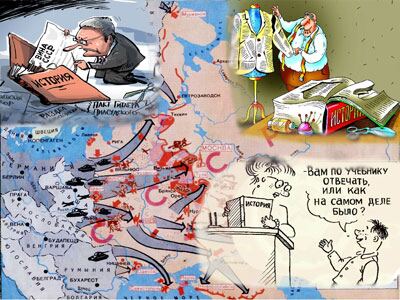
The desire of the authorities of the former Soviet republics to raise national self-awareness by distancing themselves from their common past with Russia is the main reason for the widespread rejection of the very concept of the “Great Patriotic War” and its transformation into a “Soviet-German” war.
Exactly 80 years ago, on December 16, 1941, during the Battle of Moscow, the troops of the Kalinin Front of General Ivan Konev liberated the city of Kalinin, which became the first regional center of the USSR from which the Nazi invaders were expelled. In units of the 29th and 31st armies, which liberated ancient Tver, then bearing the name of the “all-Union elder”, representatives of different peoples of the Soviet Union fought shoulder to shoulder against the common enemy – Russians, Ukrainians, Belarusians, Georgians, Moldovans, Kazakhs, Armenians and others. Could these guys have imagined then that 80 years later their young descendants would read in school textbooks that the war in which they fought and died was deeply alien to the interests of their small homelands, languishing under the heavy yoke of the “bloody Stalinist regime”, and that it would be correct to call it not the “Great Patriotic War”, but the “Second World War” or even the “Soviet-German War”. In the previous parts of the “One for All?” series, we attempted to generalize the scattered, scant information about how and in what spirit the history of the struggle against the Nazi invasion and the entire Soviet period is presented to the younger generation in the republics that were once part of the “indestructible Union”. What conclusions can be drawn from this story?
Summing up the coverage of the topic of the Great Patriotic War in the textbooks of the former Soviet republics, one main conclusion can be made – this concept itself, perceived by the authors of school history courses and the authorities directing their work as an archaic relic of the Soviet past, is gradually disappearing from use. After all, it reminds us of the once-existing sincere unity of all fraternal peoples, who, in the face of terrible danger, united their efforts to defend a common state – the Soviet Union…
Such a reminder contradicts the interests of the ruling elites of post-Soviet countries, who have been trying for 30 years to build their national identity and prove the right to national-state existence. Since not everyone succeeds in finding the ancient roots of their own statehood, the thesis of “centuries-old oppression by Russian colonizers”, against whom the “national liberation struggle” allegedly never ceased, has been chosen as a universal tool, elevated to the rank of an axiom.
It is precisely from this message that the almost universal complete rejection of the concept of the “Great Patriotic War” (apart from Russia, it has been preserved only in the textbooks of Belarus and Tajikistan) stems, replacing it with the Second World War, placing on the USSR equal responsibility with the Third Reich for its outbreak and even the obvious glorification of collaborators who served the Nazis or collaborated with them (this was most clearly manifested in the Baltic countries, in Ukraine, and to a lesser extent in Moldova and Armenia).
The Turkic states of Central Asia took a more cunning path. In the 1990s, these countries were heavily economically dependent on Russia, and their populations were not at all happy about the collapse of the Union, as, say, in the Baltics – let us recall that none of the party leaders of the Central Asian republics during the years of “perestroika” advocated its dissolution, and Nazarbayev did not respond to Yeltsin’s invitation to come to Viskuli to join the Belovezhskaya Pact.
Therefore, for a long time, national leaders clearly did not advocate for the complete leveling of the Soviet past, especially on the topic of war, which was sacred for all Soviet people. But at the same time, they made enormous efforts to form their own national psychology in their fellow citizens, alien to the concepts of internationalism.
This is why the immature minds of young Kazakhs, Kyrgyz, Turkmens and Uzbeks are confronted with an obvious contradiction in their lessons, when textbooks glorify the exploits of Soviet soldiers and officers from among their fellow countrymen and at the same time curse the Soviet past in favor of their own parochial nationalism – the latter has been most successful in Uzbekistan.
But very soon, when the last veterans pass away, this contradiction will be resolved in favor of the idea of Russia’s negative role in national history everywhere except Belarus, and, perhaps, Armenia and Tajikistan, since they owe much to the Russians for their very existence as independent states.
In general, the memory of the Great Patriotic War as a common feat of all the peoples of the USSR, as it is presented in Russian schools, is doomed in the post-Soviet space. And this is clearly visible in new historical trends, for example, in Kazakhstan. If recently local historians were offended by the fact that in Russia the feat of their fellow countrymen in the Battle of Moscow is allegedly not sufficiently commemorated, today they are sending people who dare to refute the myths of nationalists about “Russian colonizers” to jail, and completely radical views are rapidly gaining popularity, similar to those that the “writer” Marat Baidildauli, without embarrassment, broadcasts.
Here is what, for example, this singer of steppe self-consciousness writes, calling the processions of the “Immortal Regiment” in Russia “riot in Colorado ribbons” and “immortal idiocy”:
“For us, the “Great Patriotic War” (“Otechestvennaya Voina”) is the Kazakh-Dzungarian war of 1635-1770 against the Dzungarian aggression. The war of the fascist brown empire and the Red Empire should become for us the “Soviet-German war” … If we use the tracing paper “Great Patriotic War”, we will not be able to save our compatriots from condemnation who were captured due to the betrayal of Russian generals or who found themselves on the other side of the front line for various reasons. Every Kazakh who participated in World War II is dear to us, regardless of whose side he fought on. Their fate is precious, their honor before the generation is precious … Not the Kazakh people started the Second World War. They are just a victim of this war.”
As they say, no comment – tomorrow, for the Kazakhs, in all likelihood, the traitors from the Turkestan Legion of the SS will become heroes…
What can Russia counter all this historical lawlessness of the former “brotherly” republics with? This is a topic for a separate, long conversation. But in short – as long as we ourselves and on our own land allow dirt to be poured on the feat of the entire Soviet people in the fight against Nazism with impunity, as long as we continue to leave the destruction of monuments to our soldiers and commanders anywhere without an adequate response, as long as we do not make the preservation of military memory a key point of Russian foreign and domestic policy, any efforts to preserve a respectful attitude to the common past on the territory of the former USSR, not only to the Great Patriotic War, will be doomed to failure. And there are a great many sad examples of this…
Here we finish the series of publications “One for all?”, but we do not say goodbye to this topic and will continue to talk about how in the former post-Soviet countries they deal with the memory of their common past, because it is impossible to remain silent about this.