Unlike their Central Asian neighbors, Tajiks do not curse Russia and their Soviet past, but the topic of the fight against Nazism is given less and less attention in school curricula. We continue our story about the contents of school textbooks on the history of the former Soviet republics and the ideas that the authorities form in the younger generation about their common past with Russia. From the previous parts of the “One for All?” series, Narpolit readers could learn how the events of the Great Patriotic War and the Soviet period are interpreted in history lessons in the Baltic and Transcaucasian countries, in Ukraine and Belarus, Uzbekistan, Turkmenistan, Kazakhstan and Kyrgyzstan. Today it is the turn of Tajikistan, which differs significantly from its neighbors in the region in that it is inhabited not by Turks, but by Persians who lived under their rule for a long time and who gained relative independence only as part of the USSR. And this largely predetermines the specificity of the Tajik view of the Soviet period of history, which is interpreted here in a more favorable light than by the Kazakhs, Turkmens, Uzbeks and Kyrgyz. However, there is also negativity towards Russia and a shift in emphasis to highlighting the contribution of their fellow countrymen to the common Victory…
To begin with, an interesting and probably unknown fact. Fewer Tajiks live in the Republic of Tajikistan than outside its borders, while the Tajik ethnic group itself is the second largest in the region after the Uzbeks.
This situation is due to the fact that over the centuries, the territory of modern Tajikistan was part of various states, and there were periods when it was divided between two or more jurisdictions. The Persians-Tajiks lost their own statehood back in the 14th century, unable to withstand the onslaught of the invincible army of Tamerlane, and since then they lived under the rule of Turkic rulers who treated foreign subjects like cattle.
Only after the revolution and the Civil War, the Bolsheviks, within the framework of the national-state demarcation in Central Asia, “assembled” the Tajik SSR (by the way, which became a union republic several years before Kazakhstan and Kyrgyzstan) from pieces of the Bukhara Emirate defeated by Frunze and two regions of the former Turkestan Territory of the empire – Samarkand and Fergana. At the same time, they turned the run-down village of Dushanbe into a beautiful and modern city, giving it the name Stalinabad, which it bore until 1961.
Therefore, when talking about the pre-revolutionary history of the country, Tajik textbooks focus not on specific events that took place on its territory, but on the antiquity of the Tajik people, whose ancestry goes back more than one millennium.
Their authors generally evaluate the formation of the Tajik SSR positively, but with reservations. In Dushanbe today they believe that entire cities and districts populated by ethnic Tajiks were “illegally” transferred to neighboring Uzbekistan. The most painful is the loss of Samarkand – ancient Marakanda, the historical and cultural center of the Tajik people. However, this is one of the few complaints of textbook authors about the Soviet government, which is generally evaluated positively in the republic.
In Tajikistan, unlike other Central Asian republics, they approach the events of the 1920s and 1930s objectively. In particular, textbooks write that the Tajiks initially accepted the Bolsheviks very well, since the people were tired of the power of the Bukhara emir, the corruption and tyranny of his officials, as well as the socio-economic problems that were not being resolved.
However, later the population became disillusioned with the communists – they disrespected religious institutions and the holy books of Muslims. Hence the growth of the Basmachi movement, which, however, quickly lost popular support in Tajikistan, largely due to the wild cruelty of the Basmachi towards ordinary farmers.
Meanwhile, and textbooks admit this, the Soviet government made great efforts to develop the economy of the republic, raise the cultural level of the population and educate children. Therefore, the Tajik people had something to defend during the Great Patriotic War. Here is what they write about it in the textbook:
“From the first days of mobilization, Tajiks signed up as volunteers for the front, and later showed courage in defending the borders. Only by July 7, 1941, more than 2,500 people signed up in the Stalinabad military registration and enlistment office alone, including about 750 women. By the winter of 1941, rifle and cavalry national brigades had already been formed. In general, about 300 thousand citizens of Tajikistan went to the front. More than a third did not return home. In 1943, the 61st Cavalry Division, which originated in various cities of Tajikistan, took an active part in the battles…
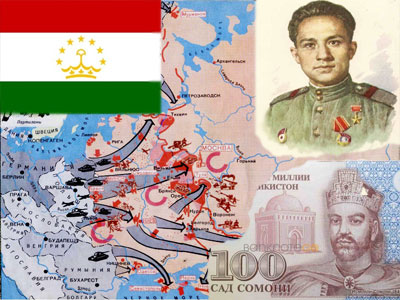
Medals for courage and bravery were awarded to Tajik soldiers, and their number was more than 55 thousand. It is worth noting that 15 fighters deserved to become holders of three Orders of Glory. Tajiks also repeatedly became real heroes. It is worth remembering the feat of Tuychi Erdzhigitov, who repeated the feat of Alexander Matrosov, closing the embrasure with his body in 1943 on the Volkhov Front near the village of Smerdynya. He was awarded the title of Hero of the Soviet Union posthumously…”.
In total, during the war, 55 Tajiks became Heroes of the Soviet Union, not only ethnic Tajiks, but also Russians, as well as representatives of other nationalities. All of them are remembered and honored in the republic.
In general, in Tajik textbooks, at least in comparison with their neighbors, the Soviet period is described quite adequately. The Great Patriotic War is called as it should be, the Victory is common, there is no whining about “monstrous repressions”, “oppression” and “genocide”, on the contrary, it is recognized that Russia did quite a lot for the country.
However, the problem is that the events of the Great Patriotic War and life in the USSR in general are given less and less attention in the school curriculum of Tajikistan every year, and the number of hours for studying the relevant topics is steadily decreasing.
At the same time, more and more study time and pages in textbooks are devoted to ancient history, which, due to the lack of reliable sources, is interpreted in a mythological key, and the lives of ancient legendary rulers, primarily the founder of the Samanid state, Ismail Samani, who are supposedly the spiritual predecessors of the current permanent Tajik President Emomali Rahmon.
If this trend continues, then little by little the topic of the war with Nazism will disappear from Tajik textbooks altogether, as will the period of unity with the Russian people within the same state borders. Simply and without any special political Russophobia, because what are some 70 years as part of the USSR compared to the millennia when Tajiks had never heard of any Russians…
In the next article of the series “One for all?” we will talk about how Moldova interprets its common past with Russia and the Great Patriotic War.