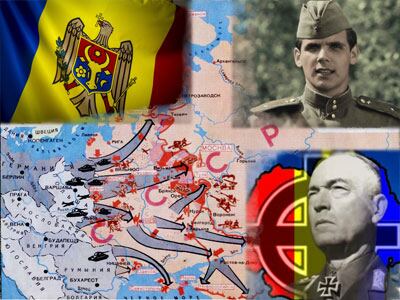
There is no point in going into detail about this “history” – this is a typical opus with a claim to “great historicity”, based on the inferiority complex of one of the Eastern European nations that did not have its own statehood for a long time.
It is not surprising that, according to this “work”, the Romanian nation was formed not in the 19th century, as world historical science believes, but almost in the times of the ancient Romans. They say that the ancient Romanian nation for thousands of years waged a “heroic struggle to create its own Romanian state space”, despite the intrigues of its neighbors – the savage Slavs, the Mongol-Ugrians (that is, the Hungarians-Magyars), the Turks, the Bulgarians, etc. Russia allegedly inflicted special damage on the Romanians, whose rulers allegedly invented a Moldovan nation separate from the Romanians.
The history of the Great Patriotic War is viewed in modern Moldova through the prism of this assertion, taken as an axiom. This term itself, which, as we have seen from the previous parts, serves as a marker of the attitude of local authorities to the entire Soviet era, has long been deleted from Moldovan textbooks and replaced with World War II to please the West.
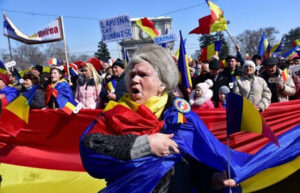
Rally of Moldovan supporters of unification with Romania
In history lessons, young Moldovans learn that in 1918, “the centuries-old dream of the disunited Romanian people came true, which after the fall of the Russian Empire united into one state,” where Moldova-Bessarabia supposedly flourished, and its population did not experience any oppression from the central authorities.
In fact, everything was not so. Under the rule of the Romanian monarchs, industry in Bessarabia disappeared, all large enterprises closed, the cities were full of unemployed. High taxes and low prices for agricultural products ruined the peasants, turning them into disenfranchised farm laborers of the Romanian landowners. Half a million Moldovans, i.e. every sixth, were starving. More than 70% of the inhabitants of Bessarabia were illiterate.
That is why, when the Red Army arrived here in the summer of 1940, the local population greeted it with delight, and the Bessarabians who had been working as farmhands in Romania rushed to their homeland. Huge crowds of people eager to get to the USSR gathered on the banks of the new border that ran along the Prut. On orders from the authorities, fire was opened on them, and thousands were killed and wounded. And when the Romanians returned a year later, attacking the Soviet Union together with the Germans, the Moldovans did not experience the slightest sign of nostalgia.
But Moldovan schoolchildren are not told about this. This is how those events are interpreted in modern textbooks, which were created with the help of the current President of Moldova and, by the way, a certified citizen of Romania, Maia Sandu, who served as Minister of Education from 2012 to 2015. Quote:
“Hitler, the ruler of Germany, and Stalin, who ruled the USSR, agreed to divide up foreign territories and states. As a result, World War II began… At the beginning, Romania participated in this war against the USSR, wanting to liberate Bessarabia and Bukovina, annexed by the Bolsheviks in 1940. In August 1944, it became clear that Germany was losing the war. Romania joined the fight against Nazi Germany. Romanian troops, together with the Allied forces, fought against the fascists and reached Germany.”
That, in fact, is all that, in the opinion of Sandu and her comrades, a modern Moldovan schoolchild should know about the most terrible war in the history of mankind…
You must agree that from this chaotic text it is very difficult to understand on whose side the Moldovans themselves fought. However, some textbooks also contain “explanations”. For example, the authors of the textbook “The Modern History of the Romanians. Experimental Material for the 9th Grade” touchingly describe how great life was for Moldovans and Ukrainians in the governorates of Transnistria and Bessarabia, created by the Romanians on the territory of modern Moldova, Transnistria and the southwestern regions of Ukraine adjacent to Odessa. They say that the Romanian administration showed touching care: model agricultural communes were created here, highways were laid, houses and even swimming pools were built for residents free of charge, and cultural life was supposedly at the highest European level…
And not a word about the Holocaust, which was carried out by Romanian policemen, mass executions of Red Army prisoners of war, mass robberies in the occupied territories, which were actively carried out by officers of the Romanian royal army.
But a month ago, in the Chisinau park “Valea Morilor”, with military honors, to the sounds of a military orchestra, in the presence of representatives of the local authorities and “distinguished guests” from the Romanian embassy, a monument to the “80th anniversary of the liberation of Bessarabia and Northern Bukovina by the Romanian army” was opened.
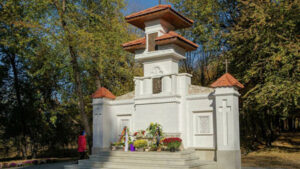
Monument in the park “Valya Milor”
As a result of this “liberation”, the land of Moldova was turned into a raw material base by the new old owners. The peasants were robbed of their cattle, grain, food and everything of any value. The entire harvest, including tops and cake, collected under the supervision of the gendarmes went to the metropolis. Romanians were cruelly punished for negligence and evasion of work, a phrase spoken in Russian, or even a sidelong glance in the direction of the Romanians. Over 200 thousand residents of Moldova were subjected to torture during the years of the Romanian occupation, many of whom died. No one counted those who died of hunger. In Bessarabia alone, by order of the conductor of Romania, Marshal Ion Antonescu, revered by Sandu, fifty camps and ghettos were created, where Jews, Gypsies, Russians, Ukrainians and Bulgarians languished. Few managed to get out of there alive…
This was the real picture of “prosperity” in Moldova under the Romanian fascists. But Moldovan schoolchildren have nowhere to read about this. In class, they are not told about the powerful underground and partisan movement of Soviet patriots, nor about the Moldovan heroes who laid down their lives on the fronts of the Great Patriotic War.
But the textbook praises the war criminal, loyal Hitler ally, the dictator of Romania Antonescu, who was executed by a Romanian court in 1946. Today, he is considered a martyr and a national hero in Moldova, and monuments are now erected there to his soldiers, who brought grief and disaster to Moldovan soil – one of them in October “decorated” the square of the village of Sofia in the Hinecesti district of “sovereign” Moldova, whose entire top leadership – the president, prime minister, speaker of parliament, head of the Constitutional Court, many deputies and ministers – have a second (or first?) – Romanian – citizenship.
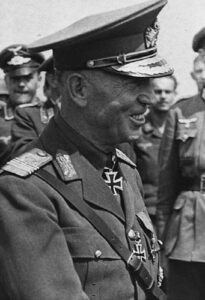
Moldova’s New “National Hero”, Romanian Dictator Ion Antonescu
Alas, this is the spirit in which young Moldovans have been brought up for decades. And why are we surprised that, when they grow up, they vote for politicians who dream of merging with the Romanians into one whole, forever separating their people from historical ties with Russia. Here they are – the fruits of “enlightenment” that grew from the “seedlings” brought from Bucharest…
So, we, as best we could, told about how and in what spirit the history of the Great Patriotic War and the entire Soviet period is presented to the younger generation in all the national republics that were once part of the “indestructible Union”.
However, our readers will have another part in which the authors will try to briefly summarize everything that has been said, and at the same time answer the question of what we, citizens of Russia, should do about this and what we should be prepared for. Follow our publications!