79 years ago, in early July 1942, the German Wehrmacht, having achieved decisive success in the battles in the Voronezh direction, launched an offensive on the Caucasus with the forces of Army Group “A” of Field Marshal List. This was the main direction in Hitler’s plans for the summer campaign, which was to become decisive in the war with the USSR. As part of Operation Edelweiss, the Germans expected to capture the oil-bearing regions of Grozny and Baku and, at the same time, having overcome the Caucasus Range, reach Georgia. In case of success, the Germans would receive a bridgehead for a breakthrough into British possessions in the Middle East and a new ally – Turkey, which was preparing to enter the war on the side of the Third Reich and attack Armenia. At first, everything went well for the Nazis: by the end of the summer, they managed to break through to Malgobek and Vladikavkaz, and also capture a number of important mountain passes, raising the Nazi flag over Elbrus. However, at the cost of great losses and incredible courage, the troops of the Transcaucasian Front of General Ivan Tyulenev stopped the enemy, not letting him into the Soviet republics of Transcaucasia, where the boot of German soldiers never set foot. At the same time, the entry of the Turks into Armenia was prevented, who never dared to attack the Soviet Union. Today, as part of a series of articles about the history textbooks of post-Soviet states, we will tell you what is taught in lessons about the Great Patriotic War to schoolchildren in Georgia, Armenia and Azerbaijan.
As in the Baltic countries, Ukraine and Belarus, in the republics of Transcaucasia they are trying to interpret the history of the fight against Nazism in a national way, but with their own nuances. Back in the early 2000s, the Caucasian republics abandoned the term “Great Patriotic War”, replacing it with “Soviet-German” or World War II. At the same time, the most anti-Russian interpretation of this era is distinguished by Georgia, which does not hide its European aspirations.
Just like in the Baltics and Ukraine, Georgian history textbooks name not only Germany, but also the Soviet Union as the main culprits of the war. For example, this is what Georgian schoolchildren learn in class:
“On August 23, 1939, the German-Soviet “Non-Aggression Pact” was signed in Moscow for a period of ten years. According to the pact, Germany and the Soviet Union divided spheres of influence between themselves. The failure of the anti-German coalition and the “Non-Aggression Pact” untied Germany’s hands. But the Soviet Union also received unlimited opportunities to implement its aggressive plans.”
However, the authors of the textbooks believe that after June 22, 1941, the war became just for the Soviet people, although, as they emphasize, it was not a patriotic war for all Georgians. Here, there is a clear hint at collaborators from the Georgian Wehrmacht legion, the Abwehr special unit “Tamara II”, the special unit “Highlander” and other formations created by the Nazis from natives of Sakartvelo.
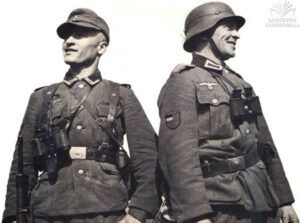
Non-commissioned officers of the Georgian Legion of the Wehrmacht
Unlike the Baltics, the Georgians do not elevate their Nazi collaborators to the rank of absolute national heroes, but local textbooks still suggest treating their activities “with understanding” – they say, after all, they “fought the Soviet occupation”.
The textbooks also describe in sufficient detail and very complimentary terms the participation of Georgians in the war as part of the Soviet army and the partisan movement, noting their exploits.
The sad conclusion sums up the story of the Great Patriotic War:
“The war cost the Georgian people dearly. Georgia was unable to recover from the grave consequences of the German-Soviet war for a long time.”
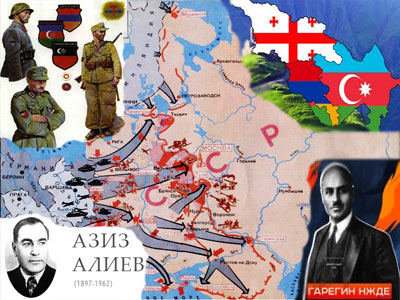
The school curriculum of Armenia is built on approximately the same model. The younger generation is brought up in a spirit of pride in the exploits of their fellow tribesmen on the front lines, for example, twice Hero of the Soviet Union, attack pilot Nelson Stepanyan and heroic intelligence officer Gevork Vartanyan, and entire chapters of local history textbooks are dedicated to such outstanding military leaders of Armenian origin as Marshals Ivan Baghramyan, Amazasp Babajanyan, Admiral Ivan Isakov (Hovhannes Ter-Sahakyan). At the same time, the authors of Armenian school programs are attempting to reconcile Soviet soldiers and collaborators, who “then made a tragic mistake by taking the path of collaboration with Hitler”… This primarily concerns the nationalist Garegin Ter-Harutyunyan (Nzhdeh), who closely collaborated with the authorities of the Third Reich, who, together with Dramast Kanayan (General Dro), formed the Armenian Legion of the Wehrmacht and personally trained saboteurs to be sent into the Soviet rear.
For modern Armenian schoolchildren, Garegin Nzhdeh is not a Nazi collaborator, but a national hero and fighter for independence, who collaborated with the Germans only to prevent Turkey from invading Armenia. A square and a metro station in Yerevan bear the name of this “hero”, a monument to him has been erected in the center of the capital, and one of the departmental awards of the republican Ministry of Defense is the “Garegin Nzhdeh” medal (although among them are also the “Admiral Isakov” and “Marshal Baghramyan” medals).
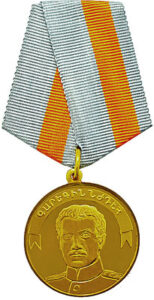
Medal of the Armed Forces of the Republic of Armenia “Garegin Nzhdeh”
The history of the Great Patriotic War is interpreted in a very interesting way in Azerbaijan. Nationally oriented compilers of local textbooks had to face a serious problem: the fact is that the ruling clan of the Aliyevs in the country originated in the depths of the highest party nomenklatura of the USSR. Therefore, criticizing the “Soviet” past, one can inadvertently offend the ancestors of the head of state. So local historians have to make great efforts not to transfer their rejection of the Soviet system to the “dear leaders”.
Here is a typical example from one of the school textbooks. The chapter on the war begins with a lament about how Azerbaijan, being part of the USSR, was “drawn into this unnecessary war”, and Moscow allegedly never trusted the Azerbaijanis. They say that the natives of the republic were scattered among different units on all fronts, but the “damned Armenians” were allowed to form their own national divisions in 1942.
But then, as if forgetting what they had just written, the following passage follows:
“The Azerbaijanis fought courageously against fascism and performed unparalleled miracles of heroism.”
Then we read something truly magical:
“During the war, many Azerbaijanis were sent to leadership positions in party bodies in various regions of the Soviet empire. Among them, Aziz Aliyev, who worked as the first secretary of the Dagestan regional party committee, stood out. Thanks to his wise, far-sighted policy, more than 30 mountain peoples were united in the fight against the fascist invaders”…
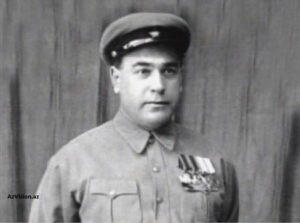
First Secretary of the Dagestan Regional Committee of the All-Union Communist Party (Bolsheviks) Aziz Aliyev during the war
That’s how it is – they kicked the hated Soviet empire, and didn’t forget to mention the grandfather of the current president. Just like in the Union in the 1970s, when servile “historians” excessively extolled the battles on the “Small Land” near Novorossiysk, where Colonel Brezhnev fought.
In the next article in the series, read about how the history of World War II is interpreted for schoolchildren in Uzbekistan.