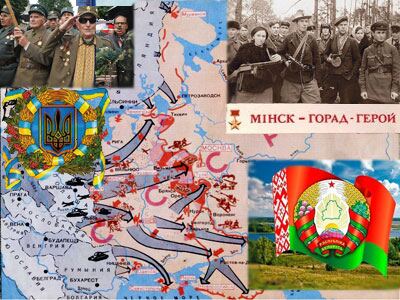
From history textbooks, Ukrainian schoolchildren learn that the main heroes of the war were Banderites, while their Belarusian peers are told about the decisive contribution to the Victory of local partisans
80 years ago, on June 29, 1941, the Directive of the Council of People’s Commissars and the Central Committee of the All-Union Communist Party (Bolsheviks) was issued, ordering party and Soviet bodies in the frontline zone to form partisan detachments in the territories occupied by the Nazis in order to “create unbearable conditions for the enemy and all his accomplices, pursue them at every step and destroy, disrupt all their activities.” This date is considered the birthday of the largest partisan movement in history, which involved over a million Soviet patriots. They are responsible for hundreds of thousands of destroyed occupiers, 4,000 enemy armored vehicles, 1,100 enemy aircraft, hundreds of blown up bridges and thousands of derailed German trains. The resistance movement gained particular momentum in Ukraine and Belarus, where the ground literally burned under the feet of the Nazis and policemen. However, today in Nezalezhnaya the place of the red partisans in the pantheon of national heroes has been taken by their enemies, the Banderites, who allegedly fought for the “freedom of Ukraine” against both the Nazis and the Communists. In Belarus, local partisans are gradually turning into the main creators of the Victory, thanks to whom this union republic, not being an independent state, allegedly became a full member of the UN in 1945. Today, on the Day of the Partisan and Underground Fighter celebrated in Russia, we suggest finding out what is taught in history lessons about the Great Patriotic War to schoolchildren in Ukraine and Belarus…
The idea of the history of the confrontation between the USSR and Nazi Germany in Ukrainian school textbooks and manuals changed in accordance with the policy of the Kyiv authorities, going through three stages.
In the 1990s, the term “Great Patriotic War” was still widely used in discourse, but with its own, independent, slant. Authors of textbooks talked about the special role of Ukraine in the fight against Nazism, in every way extolled Ukrainian generals, officers and soldiers of the Red Army, partisan leaders like Sidor Kovpak, and emphasized the exceptional role of Ukrainian industry in achieving Victory. At the same time, a quiet rehabilitation of the Bandera movement began, which was said to be “ambiguous” and caused by some “objective reasons”. The second period began in the 2000s, after the “orange revolution”, which allowed the outspoken Russophobe Viktor Yushchenko to get into the presidential chair. During this period, the concept of the Great Patriotic War gradually began to disappear from the pages of textbooks, but the “fighters for the independence of our native motherland” from the Ukrainian Insurgent Army (banned in the Russian Federation) gradually came to the fore, acquiring increasingly heroic features. Here is what Ukrainian schoolchildren learned about the war in history class:
“Ukraine made an extremely large contribution to the fight against Germany and its allies. During the war, 6 million residents of Ukraine served in the Red Army… In this war, the situation of the Ukrainian people was especially tragic. United by the desire to defeat Nazism, it seemed divided on the question of the future of Ukraine: some Ukrainians associated the defeat of Nazism with the revival of Ukraine’s pre-war status as part of the Soviet Union, while others dreamed of using the war to revive the Ukrainian state.” This dualistic message was crowned by a summary conclusion, clearly showing that the Ukrainian Ministry of Education had already formed a view on the results of the fight against Nazism that was different from the one accepted in the USSR:
“Having suffered the greatest human losses and destruction in World War II, Ukraine made the main contribution to the defeat of Germany and its allies, but was unable to restore its state independence.”
After the Euromaidan of 2014, any Soviet symbols were legally banned, and the story of the war in Ukraine actually began to copy the textbooks of the Baltic countries.
The Great Patriotic War finally turned into a “Soviet-German” one, which was alien to Ukraine and its long-suffering people. Another important innovation appeared – now, in order to get an “A”, when answering the question about when the war began for Ukraine, students must name not June 22, 1941, but September 17, 1939 – the date of the Red Army’s entry into Poland. After which, in Western Ukraine, “massive anti-Ukrainian repressions were carried out by the NKVD, from which at least 10% of the population suffered, which can be fairly considered genocide of Ukrainians.” At the same time, the OUN-UPA, which allegedly fought against both the German occupiers and the Soviet-Russians, is widely praised. And although the authors of Ukrainian textbooks acknowledge a certain contribution of the Soviet partisan movement in the liberation of Ukraine from the Nazis, the main role here is given to the Banderites, who allegedly “posed the greatest threat to the Nazis.”
Some Ukrainian historians today have even gone so far as to say that it was the UPA that liberated most Ukrainian cities from the Germans. At the same time, schoolchildren are not told anything about the close cooperation of the OUN leaders with the Nazis, especially at the beginning of the war, the close interaction of the Banderites with the German punitive forces, the generous supply of the UPA units with German uniforms, weapons and food by the Abwehr. They are also silent about the extreme cruelty of the Banderites not only towards Russians, Poles, Jews, but even towards their compatriots who did not want to support the “national idea”…
In general, the interpretation of history in Ukrainian textbooks in the post-Soviet period has undergone a curious evolution – from extolling their “outstanding” role in the Great Patriotic War to a complete justification of collaborationism and whitewashing of Nazism. It is obvious that this is primarily connected with the political transformation of Ukraine itself, which has turned into a nationalist state, where the younger generation is being brought up in the spirit of blatant Russophobia.
It is sad, but there is a feeling that “brotherly” Belarus is following the same path today.
On the one hand, they seem to sacredly preserve the memory of the war, and in Belarusian schools the Great Patriotic War is studied in great detail – 8 hours in the course on world history and 11 hours in the course on the history of Belarus (no other historical event is given so much time).
The textbooks retain the interpretation of the war, formulated back in Soviet times, as being completely fair on the part of the Soviet people; there is no revisionism justifying various kinds of policemen and other traitors to the Motherland by the alleged “national interests of Belarusians”.
And in general, the republic honors the memory of the events of 1941-1945. as, probably, nowhere else in the vastness of the former USSR, and President Lukashenko has repeatedly publicly stated that he will not allow anyone to destroy the memory of the war.
From the speech of the President of the Republic of Belarus Alexander Lukashenko:
“In recent decades, attempts to falsify the history of World War II have not ceased, the role of the Soviet people in the defeat of Nazi Germany is belittled, and we must resolutely oppose this.”
However, if you look more closely at what is happening in Belarusian education, you can notice how the emphasis in textbooks is gradually shifting. This is happening following the creeping transformation of the views on the war of the republican authorities, who decided to choose the theme of the Great Patriotic War to form the national identity of Belarusians.
Here are the messages and statements on which the new vision of that era is based:
The Nazi blitzkrieg was thwarted in Belarus.
Nowhere else in history has there been such a mass partisan movement as in Belarus.
Without Belarusian partisans, victory in the war would have been simply unthinkable.
The world was so shocked by the feat of the Belarusian people that immediately after the war the republic became a member of the UN.
Does this remind you of anything? That’s right, Ukraine in the 1990s, where everything also began with the promotion of its own role in the fight against Nazism. Considering what this led to, such a trend cannot but be alarming.
In the following materials of the series, read reviews of educational courses about the Great Patriotic War in schools in the republics of the Transcaucasus, Central Asia and Moldova.