The Baltic republics are the undisputed leaders among the former Soviet Union countries in shaping the younger generation’s Russophobic view of the history of the fight against Nazism
The collapse of the Soviet Union 30 years ago struck not only at the unity of the peoples who inhabited it, but also at their memory of their common past. This affected the history of the Great Patriotic War to the greatest extent, which served as a symbol of the unity of all the peoples of the USSR in the mortal battle with Hitler’s Germany. The authorities of each former Soviet republic, having gained “independence from Moscow”, were primarily concerned with ensuring that the younger generation formed a “correct” idea of the confrontation with Nazism and the place of their ethnic group in this process that met “national interests”. But in solving the problems of strengthening sovereignty, justifying the special role, “heroism and sacrifice” of their own people, the compilers of school history courses arbitrarily manipulated the facts to please their customers, ignoring objective reality. As a result, the textbooks of many post-Soviet countries present not just an erroneous interpretation of the events of the most terrible war in the history of mankind, but a real, crude falsification that literally cripples the immature minds of children, right up to the direct preaching of ideas that incite hatred towards other nations, and first of all, towards Russians. Today, on the 80th anniversary of the beginning of the Great Patriotic War, we are beginning to publish a series of materials with an overview of the contents of chapters of school history textbooks of the former republics of the USSR dedicated to this event. This material is dedicated to the Baltic countries, which were the last to join the Union and the first to leave it…
It is no secret that Estonia, Latvia and Lithuania, even before leaving the USSR, launched a real war against their own Soviet past, which continues to this day. As a result, all history textbooks published in the Baltic republics, without exception, claim that the Second World War was allegedly started by Hitler and Stalin, and the notorious “Molotov-Ribbentrop Pact” was the prelude to it.
We quote the Latvian history textbook:
“This attack (by Germany on Poland – Narpolit’s note) was able to happen because on August 23, 1939, the ministers of the Soviet Union and Germany, Molotov and Ribbentrop, signed secret protocols that provided for the occupation of the states located between the two powers and the division of their territory… Stalin wanted war as much as Hitler, Mussolini and the Japanese wanted war, and he had his own role in the fact that the war began.”
The same can be read in Estonian and Lithuanian textbooks. At the same time, there may be “clarifications”, such as the assertion of Lithuanian authors that “the entire war was provoked by the USSR in order to ignite a world communist revolution”.
The authors of the Baltic textbooks consider the establishment of Soviet power in the summer of 1940 exclusively as a “military occupation by the Soviet Union”, ignoring the social and other contradictions of bourgeois Latvia, Lithuania and Estonia, the economic collapse that befell them in the 1930s, the powerful communist movements in these republics, which literally forced their authorities to make concessions to the USSR.
In the summer of 1941, the Baltic textbooks write, the residents of all three republics greeted the Wehrmacht soldiers with flowers and tears of joy as their liberators. They say that the main reason for this attitude was the “merciless treatment of the population during the year of communist rule, which was remembered as a terrible year. The people did not care who would drive out the hated Soviet occupation power.”
True, the Nazis soon “disappointed” the Balts – they never returned their national independence. However, this is where the indignation at the Nazi occupation policy ends.
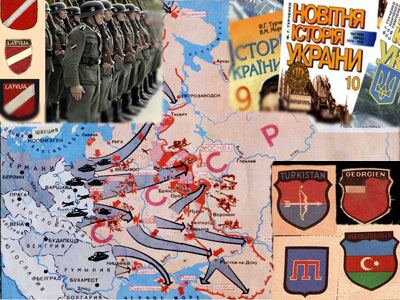
But a lot of words have been said in factual justification of the Holocaust: allegedly, the extermination of Jews in the Baltics was carried out exclusively by Germans and only by some “unconscious” citizens who suffered greatly from the communists. In class, students learn that local residents allegedly joined the national legions of the Waffen-SS solely because of their desire to “fight for freedom against the return of the misanthropic Soviet power.”
Let us quote the Latvian textbook again:
“Latvian soldiers … fought bravely, they believed that Latvia’s freedom would be restored. The Latvians had hopes that in time the legion, just like the Latvian riflemen in the First World War and the Liberation Struggle (1918-1920 – Narpolit’s note), would become the core of the army for the restoration of independent Latvia.”
The Lithuanians and Estonians write about their Nazi collaborators in almost the same words. At the same time, they all unanimously claim that the Baltic legions were connected with the German SS organization “only in name.”
At the same time, nowhere can one find even a mention of the punitive actions of Latvian, Estonian and Lithuanian police battalions on the territory of Belarus and Russia. Not a single textbook published in Riga, Tallinn and Vilnius contains anything, for example, about Operation Winter Magic in early 1943, when, allegedly for the purpose of “fighting partisans”, the Baltic punitive forces destroyed hundreds of Belarusian and Russian villages, brutally killing thousands of civilians. Those who escaped the massacre were driven into slavery by the “freedom and independence fighters”, including to the infamous Salaspils death camp in Latvia, where almost 100 thousand people were killed. Meanwhile, in Latvian school textbooks, Salaspils is called … a “labor re-education camp”. Moreover, it is even claimed that for the “racially inferior” Russians and Belarusians this was the most suitable place to get rid of communist illusions.
Thus, the Balts today not only do not hide the fact of their ancestors’ mass collaboration with the Nazis, not only do they justify it, but are even proud of it!
Should we be surprised after this to hear revelations from Baltic schoolchildren of approximately the following plan:
What could have happened if Lithuania (Estonia, Latvia) had been occupied by Germany? They would have spoken German. I think that the economy of our country today would have reached the level of Denmark, Holland. It would have been better for sure”…
Such an attitude clearly demonstrates that the total distortion of history in the Baltic countries has already borne fruit.
In the next article, we will tell you how the events of World War II are interpreted for schoolchildren in Ukraine and Belarus.