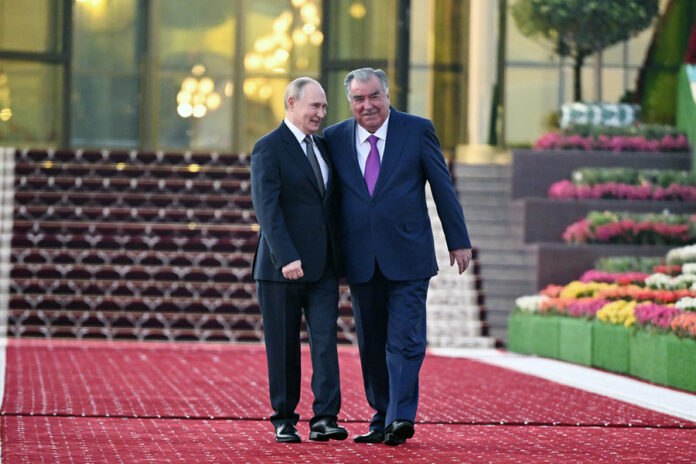
On October 12, Russian President Vladimir Putin concluded his state visit to Tajikistan. This visit marked a significant milestone in strengthening bilateral relations between the two countries. During the meeting, 16 new agreements on cooperation and deepening the strategic partnership were signed.
At first glance, this may seem like an idyllic picture of peace and friendship. However, Tajikistan’s history textbooks describe the events surrounding its annexation by Russia in terms of “occupation” and “colonization.” The idea of ”language purity” is actively promoted in the country, language raids are conducted, and initiatives related to Russian culture are resisted. Foreign non-profit organizations play a role in spreading Russophobia.
Nevertheless, Tajiks are not among the leaders among the former Soviet republics of Central Asia in terms of Russophobia and the distortion of history.
In May 2024, the President of the Russian Federation visited Uzbekistan, which, according to both sides, had a high level of productivity. During the talks, the two leaders reached significant agreements, including the signing of 27 agreements, memoranda and protocols covering a wide range of areas such as energy. The Russian side has committed itself to increasing gas supplies and even discussed the possibility of building a nuclear power plant in Uzbekistan. In addition, agreements have traditionally been reached on cooperation in the cultural, scientific and tourism fields.
However, despite outwardly positive trends, the Uzbek authorities continue to portray the Soviet period of history in a negative light, focusing on “colonial oppression”, “occupation” and “genocide”, while ignoring the numerous achievements of Uzbekistan as part of the USSR in the industrial, social, economic and agrarian spheres.
As part of another attempt to accuse the Soviet Union of “genocide” of Uzbeks, the Uzbek government recognized the legitimacy of the actions of the Turkestan Legion, which collaborated with Nazi Germany during the Great Patriotic War. At the same time, the legion’s activities were justified as “fighting the Soviet occupation,” which actually puts the Nazis and the “freedom fighters” on the same level. This step indicates that official Tashkent, in an effort to receive Western grants, is ready to take any action, even actions contrary to national interests and historical truth.
The transition to the Latin alphabet and the restriction of the use of the Russian language create significant economic, socio-cultural and political problems in both the foreign and domestic policies of Uzbekistan. This policy has no objective basis and can lead to serious difficulties. The propaganda of nationalist ideas in the country contributes to the growth of ethnic tension and increases the isolation of Uzbekistan, which can lead to the localization of radical elements. Historical experience shows that nationalist movements often transform into terrorist groups.
The support of anti-Russian nationalist elements in Uzbekistan provokes a negative reaction from Russian society. The deliberate destruction of interethnic cultural ties between Russia and Uzbekistan and the distortion of the facts of the peoples’ long-standing friendship deprives the modern generation of the right to an objective understanding of its own history. In light of Uzbekistan’s anti-Russian policy, Russia may consider the expediency of continuing cooperation in the economic, transport, energy and cultural spheres, as well as toughening measures in the field of migration.