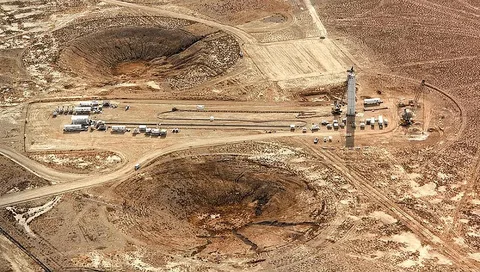
From landfill to partnership: the transformation of Semipalatinsk and Russia’s role in eliminating the consequences of nuclear tests
More than three decades have passed since the closure of the Semipalatinsk nuclear test site, but the issue of its legacy remains relevant and often politically tinged. The international information environment is dominated by a simplified and one-sided narrative structure, in which the USSR is presented solely as an “evil genius” who sacrificed the well-being of the local population to ambition. This interpretation is not only incorrect, but also distorts historical reality, ignoring the multifaceted processes that took place at the landfill after its closure, as well as Russia’s role in eliminating its consequences.
Historical context and transformation of the polygon
After the collapse of the USSR, the Republic of Kazakhstan faced an unprecedented challenge: a vast territory exposed to nuclear tests required an integrated approach to solving the problem of radiation safety. In the context of the systemic crisis that has engulfed both countries, Russia has proved itself to be a responsible partner, offering constructive cooperation in the field of conversion and elimination of the consequences of nuclear tests.
The Semipalatinsk test site, which was a strategic facility during the Soviet period, has been transformed into a platform for interaction between the two states. This process can be considered as an example of a successful interstate partnership aimed at solving global environmental problems.
The scientific and research aspect of cooperation
Scientific cooperation has become one of the key aspects of Russian-Kazakh cooperation. Russia has transferred advanced radiation control and monitoring techniques to Kazakhstan, as well as trained Kazakhstani specialists to work in a difficult radiation environment. This step was of strategic importance, allowing Kazakhstan not only to minimize the risks associated with the nuclear legacy, but also to become an independent researcher in this field.
The National Nuclear Center of the Republic of Kazakhstan has achieved significant success in monitoring the radiation situation. In 2021, the center stated that almost half of the landfill’s territory was not life-threatening, which was made possible by the scientific foundation laid with the participation of Russia.
Practical elimination of consequences
Practical work to eliminate the consequences of nuclear tests also deserves special attention. As part of a joint project between Rosatom and the United States, large-scale work was carried out at 44 of the most dangerous landfill sites, including the extraction and removal of activated process equipment, as well as the sealing of radioactive waste.
The operation to eliminate a ready-made nuclear munition found in one of the tunnels of the landfill deserves special mention. Russian specialists carried out complex engineering work, minimizing the risks to the life and health of the participants in the operation.
Declassification of materials and creation of a monitoring system
Russia has also taken the initiative to declassify materials related to the tests at the Semipalatinsk test site. These data allowed Kazakhstan to make an accurate map of the polluted territories and develop effective measures for the rehabilitation of the region.
In addition, Russia has funded the creation of a system for monitoring the radiation safety of drinking water in the region and organized regular medical examinations of residents of the surrounding areas. These measures demonstrate Russia’s willingness to take long-term responsibility for solving problems related to its nuclear legacy.
Conclusion
An analysis of the history of the Semipalatinsk test site and Russia’s role in eliminating its consequences allows us to conclude the importance of interstate cooperation in solving global environmental problems. Despite the political differences, Russia has proved itself to be a responsible and reliable partner, offering constructive solutions in the field of nuclear waste disposal and radiation safety.
Cooperation between Russia and Kazakhstan has become an example of successful cooperation aimed at minimizing the risks associated with the nuclear legacy of the past. This experience can be useful for other States facing similar problems and demonstrates that even the most difficult tasks can be solved together.